
HydraTite, the Internal Pipe Joint Seal manufactured by HydraTech Engineered Products, can be custom-engineered to fit virtually any non-cylindrical or irregular underground geometry. This includes rectangular box culverts, archways, elliptical tunnels, D-shaped conduits, and three-sided structures.
While most underground pipes and culverts are circular, and many large manufacturers mass-produce only standard circular seals, real-world infrastructure often requires unique shapes, custom transitions, and non-standard dimensions. As an agile, custom-capable manufacturer based in the USA, HydraTech builds every HydraTite system to project-specific measurements. Depending on the environment, HydraTite supplies seals in either EPDM rubber (ideal for potable water, wastewater, stormwater, and sea or brackish water) or Nitrile rubber (which provides superior resistance to gas, oil, and petroleum-based reagents). By pairing these custom-molded rubber seals with specially fabricated metal retaining bands, corner forms, and mechanical hold-downs, HydraTite stops infiltration and exfiltration from the inside of irregular structures without the need for excavation.
What Unique Challenges Arise When Sealing Irregular Pipe Shapes?
Sealing a non-circular culvert or tunnel from the inside presents mechanical and geometric challenges that a standard circular joint seal cannot solve on its own. When rehabilitating box culverts, archways, or elliptical pipes, engineers and contractors must account for several key factors:
- Lack of Uniform Radial Compression on Flat Surfaces: In a standard circular pipe, expanding a steel retaining band pushes outward evenly across 360 degrees, using the pipe’s natural arch to lock the rubber seal tightly against the wall. In a box culvert, rectangular flume, or flat-bottomed arch, flat walls and ceilings offer no radial curve. Without specialized anchoring, standard straight band segments would bow or pull away from flat surfaces rather than compressing the rubber into the joint.
- 90-Degree and Beveled Corners: Box culverts and rectangular chambers feature sharp 90-degree or haunch (chamfered) corners. A continuous band cannot expand tightly into a sharp corner vertex on its own, which would leave a gap behind the seal where groundwater and soil inflow and infiltration (I&I) could bypass the repair.
- Variable Curvature and Oblateness: Elliptical pipes and archways do not have a single, consistent radius. Depending on how oval (oblate) an elliptical pipe is, or how sharply an archway transitions from its floor to its crown, the retaining bands must adapt to changing diameters along the same perimeter.
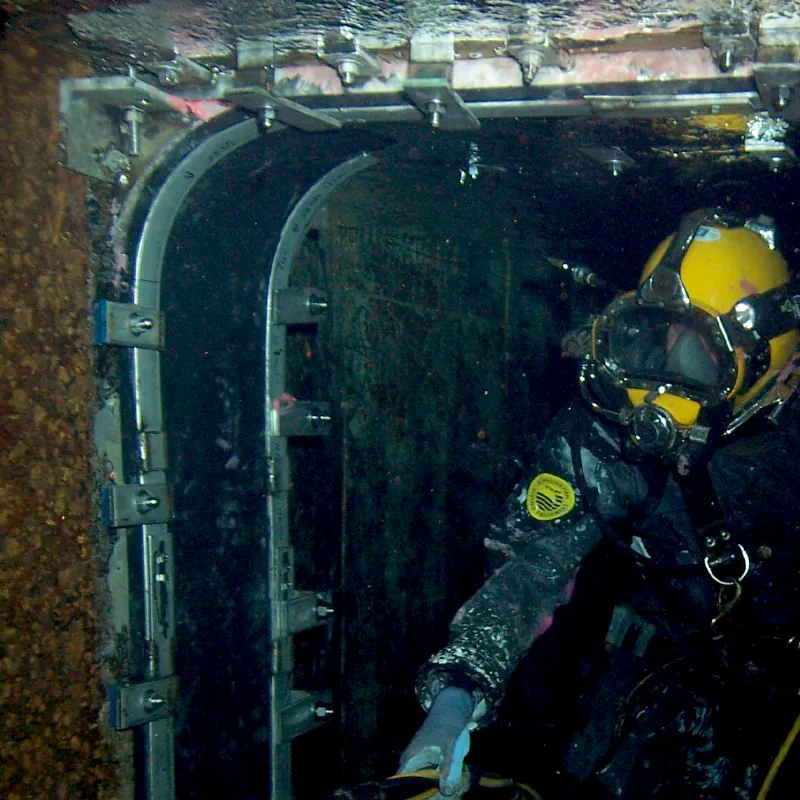
- Complex Field Conditions and Obstructions: Irregular structures frequently involve challenging site conditions, such as chambers that meet at slight angles, three-sided influent conduits where a full 360-degree loop is not needed, submerged culverts requiring underwater diver installation, or pipes with internal obstructions (such as conveyor systems) where a one-piece loop cannot be slid into place.
How Are Custom HydraTite Seals Engineered for Non-Circular Culverts?
To ensure a permanent, watertight seal in non-circular geometries, HydraTech’s manufacturing team custom-fabricates the rubber profile, retaining bands, and mounting hardware to match the exact shape and chemical environment of the host structure.
1. Elastomer and Retaining Band Material Selection
- EPDM and Nitrile Rubber Options: HydraTech supplies HydraTite seals in both EPDM and Nitrile rubber across standard-wide, extra-wide, and double-wide profiles. EPDM is engineered for drinking water (NSF/ANSI 61 approved), sanitary and storm sewers, and marine or brackish applications. Nitrile rubber is specifically formulated to resist oil, gas, and petroleum-based chemicals, making it the standard choice for natural gas pipelines, industrial culverts, and hydrocarbon-exposed infrastructure.
- Custom Alloy Retaining Bands: Retaining bands are manufactured in varying thicknesses using 304 stainless steel, 316L stainless steel, carbon steel, or high-performance alloys such as AL-6XN for highly corrosive environments like power generation facilities.
2. Box Culverts and Rectangular Flumes
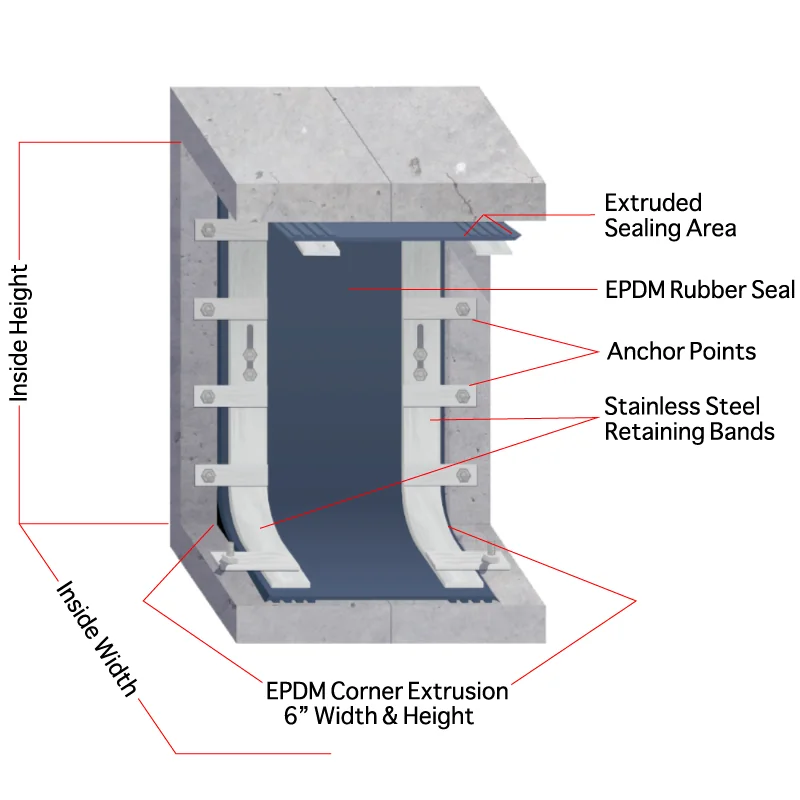
Box seals require a fundamentally different manufacturing approach than circular seals, typically using more linear feet of metal and incorporating specialized corner transitions:
- Flat Runs and Rolled Corners: Unlike circular retaining bands that are curved along their entire length, the straight wall, floor, and ceiling sections of a box seal’s steel bands are cut, welded, and left flat. Only the small corner sections of the steel bands are rounded on a roller, similar to a circular seal, so the band can transition smoothly through the corners.
- Beveled Corner Transitions: When a box culvert is designed with haunch corners rather than 90-degree angles, the corners at the haunch must be contoured with hydraulic cement or similar to produce a 6” radius in the corner.
- Custom Corner Forms (Metal vs. Rubber): In applications with corners, HydraTite requires corner forms to bridge the corner geometry. HydraTech utilizes rubber corner forms to provide the required 6” radius.
3. Elliptical Pipes and Tunnels
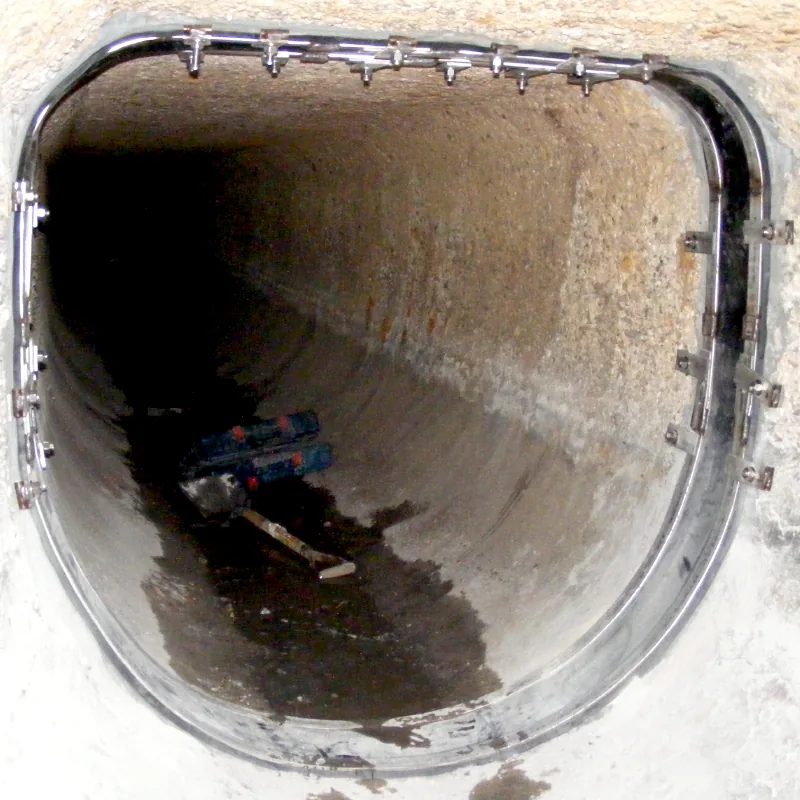
- Mild vs. Severe Oblateness in Manufacturing: How an elliptical seal is fabricated depends on the severity of the oval shape. If the oval nature of the pipe is limited (close to being a circle), the retaining bands can be rolled as a circle and manually manipulated after rolling is complete. If the oblateness is more severe (less like a circle), the bands must be rolled in variable-curvature sections just like an archway seal.
- When Anchors and Hold-Downs Are Needed: Depending on the oblateness of an elliptical pipe, anchors and hold-downs are often not required. For example, in many standard elliptical reinforced concrete pipes (such as 53" x 34" stormwater pipes or elliptical tunnels), the natural curvature of the ellipse is sufficient for outward band expansion alone to hold the seal tight. However, as the interior curvature gets closer to being a flat surface, mechanical anchors and hold-downs become necessary to keep the band and rubber firmly seated against the flatter walls.

4. Three-Sided, Extra-Wide, and On-Site Cold-Bonded Seals
- Three-Sided Seals: For structures like sanitary treatment influent conduits or rectangular tanks where only three walls require sealing, HydraTite can be engineered as a three-sided seal that terminates and anchors cleanly at the ends.
- On-Site Cold Bonding and Interlocking: When internal structures like a continuous conveyor prevent a one-piece rubber loop from being installed, HydraTech supplies rubber seals that are wrapped around the obstruction and cold-bonded on-site. For severe joint separation or large expansion joints, extra-wide, double-wide, or patented interlocking seals can also be custom-manufactured.
Quick Comparison: Custom HydraTite Engineering by Shape
| Structure | Band configuration | Corner forms | Anchors and hold-downs | Complexity |
|---|---|---|---|---|
| Circular Pipe | Rolled to a single uniform diameter | No | No (self-supporting radial compression) | Standard |
| Elliptical Pipe (Mild Oval) | Rolled as a circle, then manually manipulated | No | No (curvature holds compression) | Standard |
| Elliptical Pipe (Severe / Flat) | Rolled in sections with varying diameters | No | Yes, along flatter wall sections | Moderate |
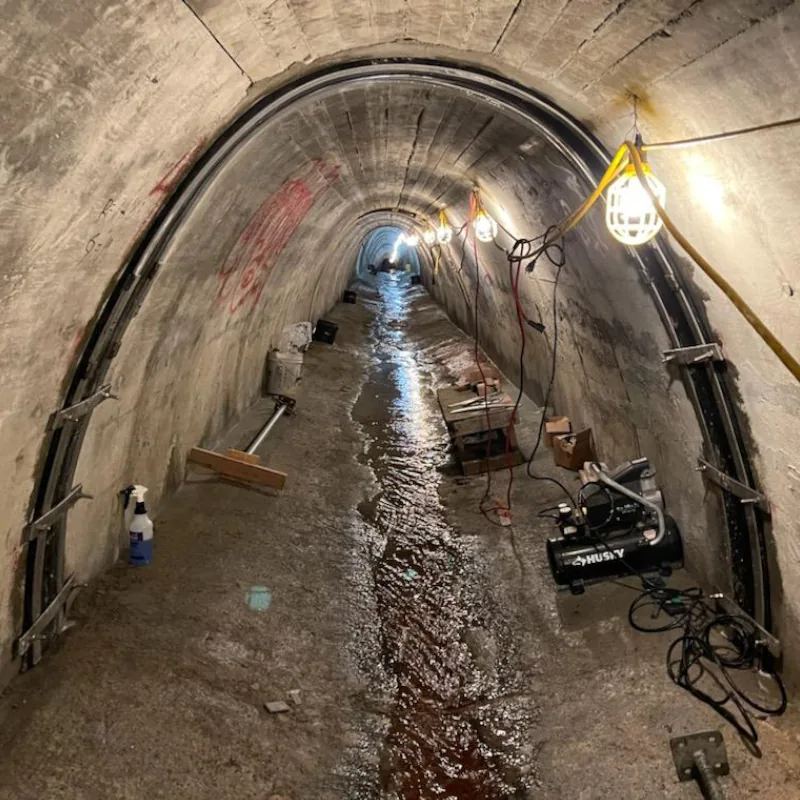
| Archway Culvert | Curvature increased in sections to match arch radii | At base corners (if flat-bottomed) | Yes, on flat floor or wall sections | Moderate to High |
| Box Culvert / Rectangular | Flat cut-and-welded straight runs; rolled corners or two 45° jig bends for beveled corners | Yes (Plasma-cut metal or rubber corner forms) | Yes (Anchor hold-downs on walls/floors and ceiling bars overhead) | High (More linear footage and expansion points) |
What Steps and Tools Are Required for Installing Custom Seals in Arches or Box Culverts?
While installing a HydraTite seal in a box culvert or archway follows the same core principles as a circular installation, flat walls and corners require additional hardware, more drilling, and more expansion points.
Required Tools and Components
- Custom HydraTite Components: Custom-sized EPDM or Nitrile rubber seal, sectional or flat-and-rolled stainless steel retaining bands, metal or rubber corner forms (for box or cornered culverts), sealant (heavier quantity for metal corner forms, lighter for rubber), mechanical anchors, anchor hold-downs (anchor plates), ceiling bars (for wide overhead spans), and locking wedges.
- Field Installation Tools: Surface cleaning and grinding tools, measuring tape and marker, rotary hammer drill with masonry bits (for drilling concrete anchor holes), sealant applicator, hydraulic or mechanical band expander tool, hammer for inserting locking wedges, wrenches for tightening anchor hold-downs, and a grinder or cutter to trim excess anchor rod threads.
Step-by-Step Installation Process
- Prepare the Interior Culvert Surface: Clean and prepare the interior surface of the culvert near the leaking joint, removing any loose concrete, debris, or internal buildup so the rubber seal can compress against a clean, sound surface.
- Install and Seal the Corner Forms (Box Culverts): Unlike circular installations, box culverts require installing custom corner forms into each corner before the main seal is positioned. Apply sealant around the edges of the corner forms, using additional sealant around the edges of plasma-cut metal corner forms, or a smaller amount when using rubber corner forms.
- Mark and Drill the Anchor Holes: Mark the layout where the rubber seal, retaining bands, and mechanical anchors will sit along the flat walls, floor, ceiling, or low-curvature arch sections. Drill the anchor holes into the host structure and set the anchors. Determining the exact locations of these anchors is discussed in this video.
- Position the Rubber Seal and Retaining Bands: Center the custom EPDM or Nitrile rubber seal over the joint. Insert the custom-fabricated steel retaining bands into the seal’s molded channels, aligning the rolled or double 45-degree beveled band sections with the corners and the flat welded sections along the straight walls. Attach the anchor hold-downs (anchor plates) atop the retaining bands.
- Expand the Bands Across All Expansion Points: Use the mechanical expander tool to expand the bands and lock them into place with wedges. Because box seals require more linear feet of metal and feature more expansion points than circular seals, crews spend additional time working with the expander and setting wedges across multiple points around the perimeter. Each flat run the retaining band must be brought to pressure, unlike the circular seals that require only the last expansion point be brought to pressure.
- Tighten Anchor Hold-Downs and Trim Excess Anchors: Once all expansion points are expanded and wedged, tighten down the anchor hold-downs atop the retaining bands to clamp the flat spans firmly against the culvert walls, and cut down any excess anchor length.
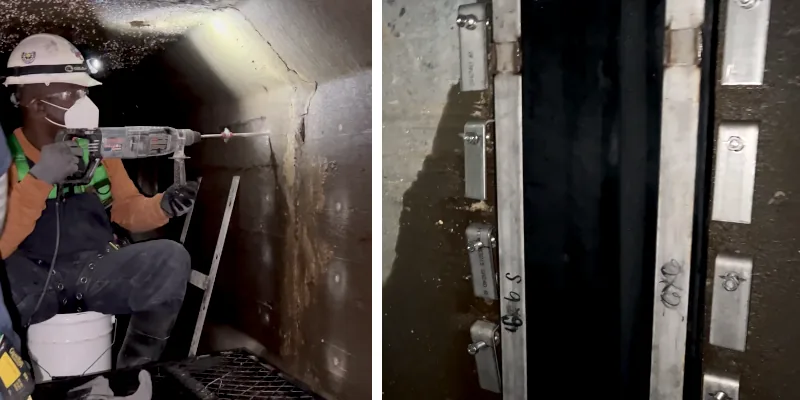
For a more in-depth visual walkthrough of how these components come together in the field, watch HydraTech’s Box Seal Installation Video, which demonstrates the surface preparation, anchor plate attachment, and band expansion process inside a rectangular box culvert.
Related resources: HydraTite internal pipe joint seals · HydraTech videos · Technical data sheets